
How to Optimize Warehouse Safety & Productivity with Drive-In Pallet Rack

Understanding Drive-In Pallet Rack System Design & Operation
Achieving the perfect balance between warehouse safety and efficiency is always the goal, and the Apex warehouse safety experts are here to help with this goal. Since drive-in pallet rack is one of the more popular pallet storage system types, there are many things to consider to ensure safe operation. The following are valuable guidelines for drive-in pallet rack system design, function, and inspection.
What is Drive-In Pallet Rack?
Drive-In pallet rack is a high-density storage solution. It is most often used to store large volumes of the same or a limited number of SKUs. The drive-in rack footprint is condensed to maximize both warehouse space and pallet density. However, that dense configuration requires that forklift operators drive into the rack structure to load and extract pallets.
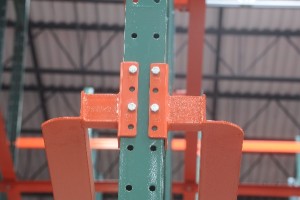
Drive-In Rack Load Rails
The pallet storage bay is open floor to ceiling with heavy-duty load rails on each level on the left and right sides. The rails run the full depth of the bay. The system stores a unique product SKU on all the storage levels. It is loaded and picked from a single aisle. Since the last pallet loaded is the first pallet pulled, drive-in supports a Last-In/First-Out (LIFO) inventory rotation.
Alternatively, drive-in can be designed with access to the opposite aisle. This is called Drive-In/Drive-Thru storage. Pallets are loaded and removed from the opposite aisle. Drive-in/drive-thru is often preferred for date-sensitive or perishable inventory with a First-In/First-Out (FIFO) inventory rotation.
Protecting Your Drive-In Pallet Rack to Ensure Warehouse Safety
Drive-In is far more susceptible to impact damage vs. other storage types because the forklift must drive into and back out of the system for each load and pick function. To protect your operation as a whole from costly damage, repairs, and worker injury, properly guard your rack system and train your forklift operators.
Guarding Your Pallet Rack System
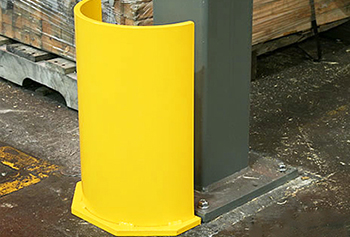
Column Protector |
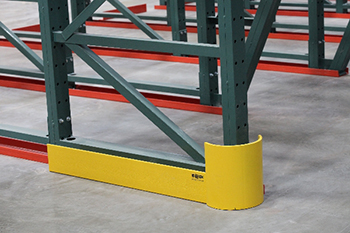
End Row Protector |
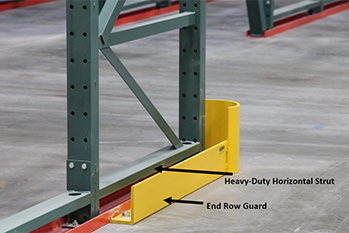
Heavy-Duty Horizontal Strut |
|
|
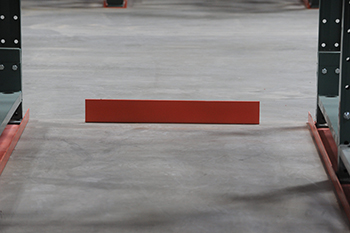
Floor Angle Stop |
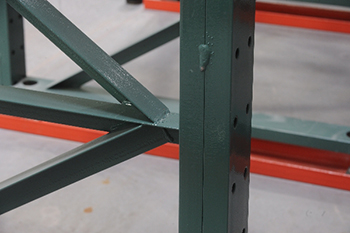
Boxed Column |
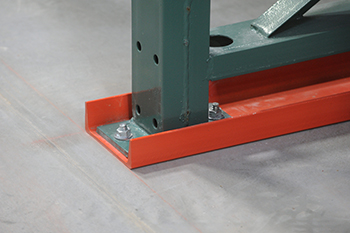 Floor Channel
Drive-in design must account for forklifts to not only drive in and back out of the system but the forks to clear the rack as the vehicle turns in the aisle. The system design must offer ample space for the operator to enter the aisle and access the rack system. Using a recessed front column is an excellent way to increase the turn radius and minimize rack strikes.
- Box Columns – Double reinforced columns provide upright protection from the floor to typically just above the first pallet level.
- End Row Guards – Heavy steel sections run along the bottom of the frame at the end of the row of rack where the system is susceptible to damage.
- Column Protectors – Attached to the front column base, column protectors absorb impact from equipment strikes without distributing it to the rack system.
- Heavy-Duty Bottom Horizontals/Rub Rails – Bolted into the lower portion of the rack frame, this durable strut prevents the upright from twisting if struck.
- Angle Stops – Angle stops are bolted to the floor at the end of the lane to guide placing floor position pallets and ensure they do not protrude into the aisle.
- Pallet Stops – Placed at the end of rails in higher positions, pallet stops prevent the pallets from sliding off the end of the rail.
- Floor Channels– Bolted between the uprights on the floor, floor channels run the length of the frame to provide forklift guidance and rack system protection.
- Heavy-Duty Double Cant-Leg Repair Kit – For drive-in systems with frequent forklift abuse and repair, heavy-duty, double cant-leg repair kits can help prevent future damage and cost for frame replacement or repair kits.

Drive-In Pallet Rack Forklift Training
Forklift operators must be well trained through an OSHA-compliant program to prevent damage and ensure efficient system performance.
Pallet size and quality are also vital to the successful use of this system type. The pallets must all be the same size, and they must be at least of good quality.
Training forklift operators to check pallets for broken or splintered boards before attempting to load the system is valuable for success. Also, drivers should check pallet load weight vs. the posted system capacity to meet the capacity requirement. Visit the Apex Operational Training Video for step-by-step loading and unloading instructions.
Important Drive-In Pallet Rack System Cautions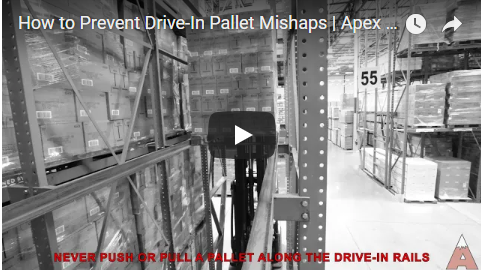
The pallets must be centered and placed on the left and right side rails. If the pallet is not secured on both rails, drivers must re-enter the system and secure it onto the forklift, center it and lower it back into place. Stops are placed at the end of rails to protect pallets from sliding off the end of the rail.
The forklift driver should NEVER attempt to push the pallet load along the drive-in rails. Pushing the pallet puts stress on the drive-in system and can cause the pallet to shift and fall through the rails causing severe damage and potential worker injury.
Can you use some help in maintaining worker and equipment safety in your facility? How about a free tool designed by the Apex safety experts?…
Are You Familiar with the Apex Rack Repair & Safety Program?
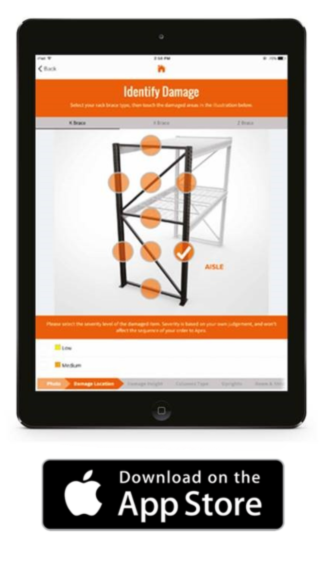 As part of our ongoing effort to support our material handling customers with complete warehouse safety support, Apex Cos. developed the Apex Rack Repair App. The app is available for free download through the iTunes App Store, and it provides users with the ability to assess and record pallet rack damage just like the professionals.
Accidents happen in busy warehouse environments. When they do, your team can quickly address the damage and determine if it’s significant enough to warrant shutting down use and ordering a custom repair or not… ALL with the Apex Rack Repair App. The app walks you through gathering the necessary specs to make the proper assessment and order a repair kit if required.
It’s a ”Do It Yourself” approach to help meet your goals of safety and efficiency.
Additionally, we recommend scheduling annual, thorough rack and warehouse safety audits with the Apex PROs. Our trained and certified rack auditors come to you and provide detailed reports and recommendations based on their findings. The Apex PROs also keep records of previously damaged areas to ensure that those areas are not repeatedly requiring repair… which indicates a more significant issue.
Every repair recommendation by the Apex Cos. team is guaranteed to be an independent, non-biased repair or replace solution… it is our Apex Promise.
We encourage you to visit our website for more information and call today for scheduling.
